In 2024 Community Builder, Brent Lucke, interviewed several Lincoln residents about the once-proposed Northeast Radial freeway project. This story is the product of those conversations - the public response, organization of Lincoln neighborhoods, and activists' work to shape our city.
More than just a Freeway Fight
The Lincoln Northeast Radial wasn’t just a roadway, and the fight over its proposed construction was no isolated instance for cities like Lincoln. Urban freeway projects of the mid-twentieth century threatened Edmonton, Alberta, Canada, tore through Omaha’s North End, and famously spawned neighborhood movements led by figures like New York’s Jane Jacobs. This story, however, is exceptionally our own. Not only in the fact that it led the City of Lincoln down a pathway of reinvestment in core neighborhoods, but in how residents with no formal authority, little financial resources, and a multi-decade late start, organized and built coalitions for impact beyond what any one group on its own ever could. This coalition eventually formalized in a grassroots organization that reorientated Lincoln’s (re)development framework. The story of the Northeast Radial is less about one freeway and more about who gets to make decisions about a neighborhood’s future.
The story for these two clashing visions begins both in the 1940s and the 1960s. It’s told at the desk of an employee from what was then Nebraska’s State Highway Department, but also at a coffee table in the Clinton Neighborhood. This story takes place in neighborhoods in decline, but also in neighborhoods with a soul – in packed sanctuaries, libraries, and community halls. The good, the bad, and the ambiguous of this story were shaped by many hands and hearts belonging to folks who had jobs, families, and passions unconnected to the workings of city hall. Ultimately, the story of the Northeast Radial isn’t just about the past, but also about who we are as Lincolnites, Nebraskans, and above all, as neighbors.
Living Memory
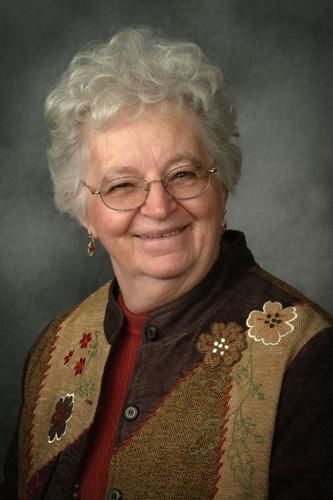
A later picture of Delores Lintel, organizer and first president of the Clinton Neighborhood Organization
Image Source: Lincoln Journal Star
It’s February of 2024, and I pull up to the curb across from an unassuming house in the Clinton Neighborhood of Lincoln, Nebraska. The modest home is painted white and features a welcoming porch with a screen door – the kind you’d leave open on a warm day. I ring the doorbell and am greeted by Bob Reeves.
Bob and his wife, Mary, are kind folks, like most long-time residents of any Lincoln neighborhood. The two have spent over 45 years in Clinton, raising a family, forging relationships with neighbors, and engaging in activism. They have pride in things that have been done, as well as regrets and uncertainties for the future. I’m invited to sit at the kitchen table and offered a cold drink. After first declining, I accept a glass of water and thank them for taking the time to share the story as they know it.
Bob, now retired, spent his career as a journalist for the Lincoln Journal Star. In 1979 he and Mary moved to Clinton and found themselves at the peak of a battle for the neighborhood. For decades, real estate agents had been pointing folks away from neighborhoods like Clinton, while current residents dug in their heels to take ownership of the once-vibrant community. The Reeves’ neighbor on 25th Street, Delores Lintel, and other women of the neighborhood shared concerns over coffee. They saw families moving out, businesses closing, and homes getting swept up, with many falling into disrepair without regular upkeep. Disinvestment, a term used to describe a retreat of both private and public funding from a community, had taken hold in Clinton.
Delores and her group started small. They partnered with Clinton Elementary to successfully repave and beautify the alley behind the school. The project became a catalyst for Lincoln’s first formal neighborhood association: the Clinton Neighborhood Organization (CNO). Founded in 1968, CNO became a north star for those who felt something was wrong but didn’t know if they had the power to do anything about it.
Digging Deeper
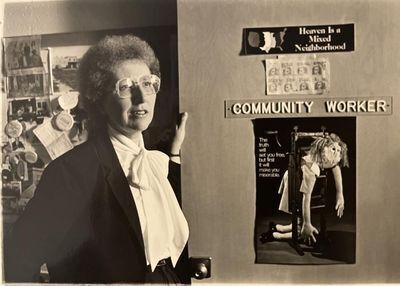
Coleen Seng, Community Organizer and later Councilwoman and Mayor of Lincoln
Image Source: Lincoln Journal Star
Clinton was not a standalone case of disinvestment and decline in social identity. University Place, once an independent village in Lancaster County, was founded in 1889 to support what is now known as Nebraska Wesleyan University (NWU). This village-turned-neighborhood was ultimately annexed into Lincoln in 1926 but still carried the markers of a distinctive community: streets bearing the names of founders and funders of NWU, and a diverse, thriving main street.
Just as in Clinton, however, things started to change in the 1950s. By the mid-1960s, former Mayor Coleen Seng recalled a “sense of unease” among residents of the area. Some had moved to south Lincoln, others east, but plenty had stayed put. University Place was also built on a solid foundation, with a developed relationship between the neighborhood, the university, and First United Methodist Church. The church’s new pastor, Ebb Munden, had previously worked in neighborhoods fighting decline in New Orleans. He convinced the congregation and other leaders in University Place to support organization around their shared issues.
This was happening in parallel, though not yet in coordination, with Delores and her Clinton neighbors. University Place formed the University Place Community Organization (UPCO), with Coleen Seng hired as a community organizer to build support and membership. Many other neighborhoods of central and northeast Lincoln soon followed.
What Had Been
On a particularly warm week for May in 2024, just around the block from Clinton Elementary, I pull up to Rose Hitz’s home. In 1946, Rose’s parents moved the family from Wilber to Lincoln. It was a different city then with fewer than 120,000 residents and a greater density of businesses, churches, and schools in core neighborhoods. A first-generation Czech American, Rose noted that her family rented a home in University Place when they arrived in Lincoln.
Like many new Lincolnites of the post-war era, access to homeownership was readily available. Housing prices declined as military operations in Air Park were reduced. Military families cleared out of North Lincoln neighborhoods, from Belmont to Clinton, leaving well-maintained, affordable homes. Decades after her parents bought a home in Clinton, Rose and her husband were able to buy a home across the street without overleveraging their finances.
By Rose’s account, neighborhood associations didn’t exist until the late-1960s because residents were already so connected. They were affiliated through places of worship, schools, common employment, and regular day-to-day interactions so they could simply act collectively without a dedicated organization or formal identity. She recalls numerous times the “women of the church” lobbied negligent property owners or the city to address run-down properties, cracked sidewalks near the school, and the care of families in hard times. A tightknit community that, by the dawn of the 1960s, started to fade away as folks moved to new suburbs at Lincoln’s edge.
Many of Rose’s neighbors moved to the recently developed Meadowlane neighborhood, and enrollment at schools like Clinton and Whittier dropped (ultimately contributing to the larger school service areas Lincoln has today). Rose and her husband were advised by a real estate agent not to put much money into their home, and to consider selling as the community anticipated an ever-expanding University of Nebraska campus to absorb the neighborhood.
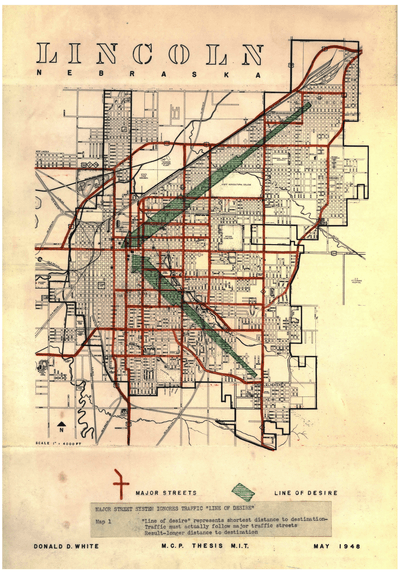
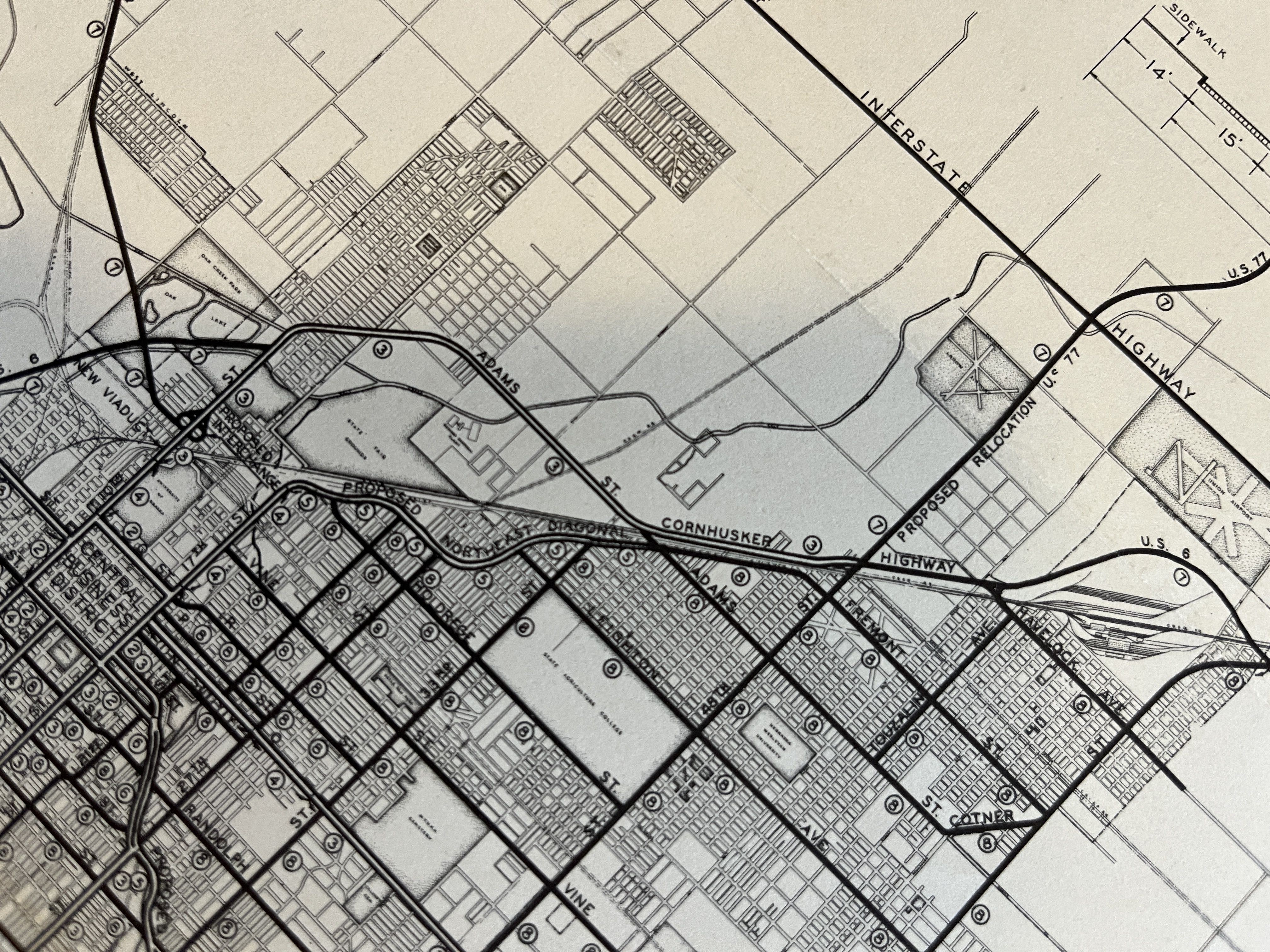
Nebraska State Highway Department travel demand map of Lincoln, circa 1946
Other People's Plans
While expansion of the University of Nebraska campuses had been a threat to the surrounding neighborhoods for decades, smoke from another fire loomed on the horizon. Across the nation, as America rode the high of post-war abundance and utopianism, the vision of Autorama and the new American Dream of suburban living (for those welcomed into the dream) drove land use and redevelopment across the continent. Visions of “perfected” urban road networks necessitated the demolition of older, core neighborhoods in cities. Freeway projects bulldozed through cities as large as New York and as small as Hartford, Connecticut. Engineers, developers, politicians, and financiers saw the future of the city, and the cure to social ills in “rational” transportation planning and separation of land uses (and people, particularly minorities) from one another.
This theory of planning, the Rational-Comprehensive approach as it’s now called, was projected by Donald White in his 1948 master’s student thesis which was drawn up as a comprehensive plan for Lincoln (the first I could find). Many of its conclusions were that Lincoln needed a series of street realignments, notably in older core neighbors, and the creation of a diagonal (radial) freeway extending from downtown to new suburban growth areas at Lincoln’s northeast and southeastern corners. Lincoln’s first, formally adopted Comprehensive Plan for 1952 echoed both the underlying theories supported by White’s thesis, and the proposal for a Northeast Radial Freeway. The plan anticipated continued urban development of Lincoln to the northeast and an assumption that the homes, businesses, and places of worship in the neighborhoods the freeway would carve through were relics of the past impeding the future growth –and by extension prosperity – of the city.
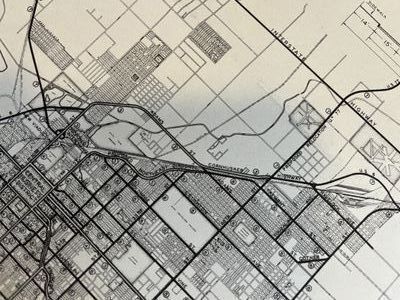
1952 Lincoln Comprehensive Plan
Proposed route of the Northeast Radial
A Peoples' Organization
Just as in other urban communities nationwide, the neighborhoods along the proposed Northeast Radial Freeway route came to know of the plan by their own investigation, not by formal notification from the City of Lincoln. However, as they learned what forces were behind the deteriorating and abandoned homes, they found ways to take the fight to the freeway and write their own narratives of their neighborhoods’ futures.
It wasn’t until the beginning of the land acquisition process in 1968 that affected neighborhoods had common, documented knowledge of the proposed route. The city pursued a piecemeal acquisition of the Northeast Radial’s right-of-way, foregoing available tools used elsewhere like eminent domain. This gave neighborhoods time to organize as the 1961 Comprehensive Plan pushed the proposed route into Lincoln’s largest majority Black neighborhood: Malone.
Fortunately, like most successful freeway-fighting coalitions of the 1960s, 70s, and 80s, the differing racial, class, and contextual formations of the most-affected neighborhoods of Clinton, Malone, and University Place didn’t impede the organization of a united front to stop their mutually realized threat.
Reverand Munden of First United Methodist Church brought not only experience from New Orleans, but also an awareness of Saul Alinsky, author of Rules for Radicals and founder of the Chicago-based Industrial Areas Foundation (IAF). The IAF provided training and resources, informed by past fights against disinvestment and destructive urban renewal projects. Organizers from a coalition of the affected neighborhoods, including renters, the City-Wide Tenants Association led by Bea Richmond, and various faith communities, formed a grassroots movement structured as IMPACT in 1972. A delegation from IMPACT received training from IAF and formed the Lincoln Alliance – Lincoln’s homegrown example of what IAF considered a “Peoples’ Organization.”
From Debate to the Ballot Box
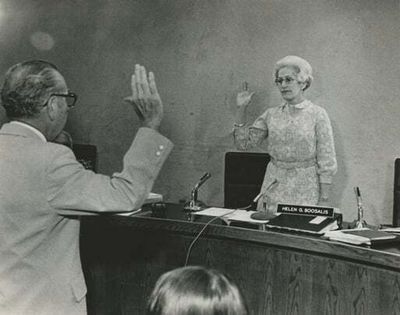
Mayor Helen Boosalis, First Woman Mayor of Lincoln
1975-1983
Image Source: Lincoln Journal Star
“Oh... we were so radical,” Coleen Seng recounted with clear sarcasm. She and I sat at her kitchen table in August of 2024, her daughter listening from the other room to occasionally assist with a name or year. Coleen’s tenure of 20 years in elected office and countless more as a youth mentor and community organizer helped her vividly recall the energy and tensions of the freeway fight and formation of the Lincoln Alliance.
Remembering the motivations of the Lincoln Alliance, Coleen was clear that it wasn’t a shared resistance to freeways at-large. The faith-, neighborhood-, and identity-based organizations in the Alliance were unified in frustration that their futures were being planned without any control of the process, or even their voices. “It was not being heard.”
Concerns about the destructive implications of the freeway did not seem to impact city hall. The affected neighborhoods, City-Wide Tenants Association, and Fremont-Area Residents Association published a booklet stating their case against the Northeast Radial Freeway in 1972’s Freeway in Search of a Reason. In April 1973 Lincoln City Council placed a hold on funding allocations for land acquisition, though by November another funding request had been made. Up until that time, councilmembers mostly hailed from South Lincoln. The mayoral administration, later deemed by Delores Lintel as “unhelpful,” listened more readily to business interests and neighborhoods south of the city.
Delores and her contemporaries consider the election of Helen Boosalis in 1975 to be the clear turning point of the Northeast Radial Freeway fight. As Lincoln’s first female mayor, Boosalis was unquestionably a boost to the Lincoln Alliance’s influence at city hall. A seasoned organizer of the League of Women Voters, Boosalis stood as an exception to previous rules of who could hold power in Lincoln politics and empowered a new coalition of voters. Her administration oversaw numerous reforms: directly empowering communities through the creation of neighborhood plans by the Urban Development Department, inviting resident representatives to task forces addressing controversial issues, and a greater presence of the mayor as a “regular Lincolnite” ditching formalities of the office like a private car and chauffeur.
The Lincoln Alliance didn’t rest on its laurels with gains coming from Boosalis’ progressive mayoral administration. The neighborhoods and faith communities of North Lincoln, still concerned with the structural makeup of City Council and a decades-long record of lacking representation, put forward a ballot initiative for a mixed election system, creating a four-year cycle of electing four of the seven seats in districts. This democratic reform ran in parallel to a back-and-forth fight regarding funding of the Northeast Radial Freeway. In the municipal election of 1978 voters made their will known and Lincoln adopted the four-member district and three at-large council make-up that continues today. It is perhaps no coincidence that, in 1979, Boosalis formerly organized the Radial Reuse Task Force with the bulk of its members carrying names and affiliations overlapping with the Lincoln Alliance.
Plans of Our Own
Specific neighborhood plans of 1976 (Malone) to 1979 (Clinton), and the city’s Comprehensive Plan of 1977 all continued to uphold the possibility of a completed (if ambiguously sized and routed) Northeast Radial Freeway. However, the death of Lincoln’s urban freeway finally came in 1980 as a last-ditch attempt to fund its construction by ballot imitative was overwhelmingly defeated (17,524 to 1,644), reaffirming Lincoln City Council’s 5-to-2 vote to end funding for land acquisition earlier that year. Boosalis' Radial Reuse Task Force formulated a vision for Northeast and Central Lincoln, which, with the assistance of a team of urban designers and planners provided by the American Institute of Architects, was published under the guidance of Urban Development in 1980’s Radial Reuse Plan. From this plan, Lincoln constructed the linear park and bikeway now called the Dietrich Trail and redeveloped multi-family and mixed-typology housing to fill lots and land cleared during freeway acquisition.
Criticism of the Reuse Plan was not hard to find, however, with numerous op-eds from affected industrial uses and other business interests peppering the Lincoln Journal Star for months. These opposing groups mirrored the same level of passion that neighborhood groups demonstrated in their publication of Freeway in Search of a Reason and the countless resident submissions to the now-defunct Lincoln Gazette. While compromises can be found in the implementations of today’s Reuse Plan, some components like an alternative “transportation corridor” remained ambiguous well into the 1980s.
The Legacy of Lincoln's Freeway Fighters
The Lincoln Alliance faded away in the 1980s as many of its founding members moved onto political office or other battles. However, its legacy remained through the creation of Lincoln Neighborhood Alliance, overlapping membership in the Lincoln Policy Network, and a shared playbook descending from the Rules for Radicals and IAF teachings. Today, a new group of resident leadership is actively rebuilding the Lincoln Alliance.
While affiliations and formal organization have changed over the years, Bob Reeves believes many of the lessons learned were applied in the planning and (re)construction stages of Salt Creek Roadway, Antelope Valley Parkway, and the redevelopment of eastern Malone and what is now Trago Park. The resident leadership of those plans was first called into action by the city just after the formal completion of the Radial Reuse Plan in 1992.
Despite the healing effects of the Radial Reuse and Antelope Valley projects, the scars of the Northeast Radial Freeway are still apparent, particularly in the Malone Neighborhood. Although it is a well-loved and beneficial asset to residents of all ages – whether they live at Malone Manor or spend afternoons at the Malone Center – Trago Park sits where dozens of homes, a church, and numerous small businesses of “T Town” once anchored Lincoln’s vibrant Black community. The Clinton Neighborhood, particularly along North 27th Street, lost many of its grand, stately homes that other historic neighborhoods (Everett, Near South) pride themselves on. While change is the nature of a neighborhood, most who lived through the height of rational planning in Lincoln agree that change undergone with consent of a neighborhood and to the mutual benefit of its residents is preferred over the imposition of a future planned by those isolated from it and who won’t live through its immediate consequences.
Those of us lucky enough to call Lincoln home today are still reaping the fruits of neighborhood organization, municipal partnership-building, and mutuality among neighbors that the emergent neighborhood associations of the 1970s and Lincoln Alliance stood. Their battle for the future of Lincoln’s core neighborhoods is commemorated in numerous parks along the proposed freeway corridor – UPCO, Lintel, Bea Richmond, Trago, and McWilliams Parks to name a few.
Given this piece’s publisher you likely recognize the bias, but in a Carnegie Library building, the city’s original Northeast Branch, NeighborWorks Lincoln was born in 1986 as Neighborhood Housing Services to ease access to Community Development Block Grants for home rehabilitation and neighborhood reinvestment. The Mayor’s Neighborhood Roundtable, a product of Boosalis' coordination with neighborhood associations on reinvestment projects, and, as previously mentioned, the system of selecting City Council are all clear policy and procedural outcomes of neighbors working together to make their city work for them and their communities.
Beyond the more tangible, many Lincolnites’ sense of place was first forged because of this story in the city’s history. Before the 1960s, as Rose Hitz shared, there were few identifiable neighborhoods in Lincoln. Perhaps before then, we didn’t need them. Lincoln was, despite being a capital city, truly a town. Some would even call it a small town, with less of the tongue-in-cheek of today’s “big, small town” self-description. However, without this solidarity of neighbors, this courage to come together and reject an acceptance of “well, there goes the neighborhood,” Lincoln would be a much different place than it is today. This story and the lessons we can glean from the defeated Northeast Radial are not just the tale of those that came before us. It is our story – a defining moment in the context of your life in Lincoln no matter which neighborhood you call home.
If you are interested in connecting with NWL about the Northeast Radial story please contact Community Builder, Brent Lucke, at brent.lucke@nwlincoln.org or 531.249.1565.


